
Vendor: Vendor:
Go Science
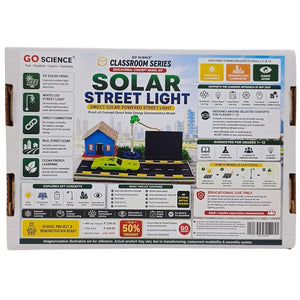
Solar Street Light School Project & Demonstration Kit Go Science Classroom Series
Ideal for your child's learning exploration and as thoughtful gift for others.
Solar Street Light School Project & Demonstration Kit Go Science Classroom Series
Description
Solar Street Light School Project & Demonstration Kit Go Science Classroom Series Educational Concept Model Kit
Pre-Wired Direct Solar Energy Demonstration Model
Capture the light. Generate DC electricity. Power the LED directly. See renewable energy in action.
Turn solar-energy conversion, the photovoltaic effect, direct-current electricity and renewable street-lighting concepts into one connected learning experience.
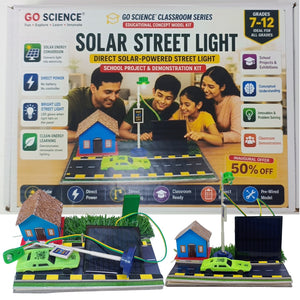
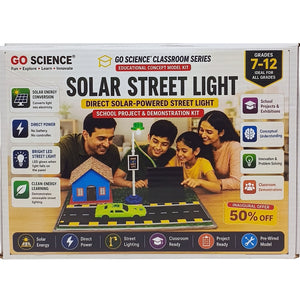
The Go Science Classroom Series Solar Street Light — Direct Solar-Powered Street Light is a pre-wired educational working model that demonstrates how incident light can be converted into electricity and supplied directly to a white LED street light.
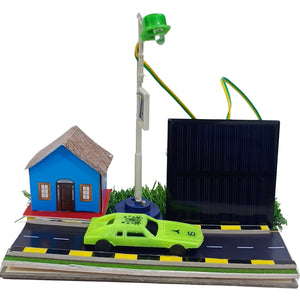
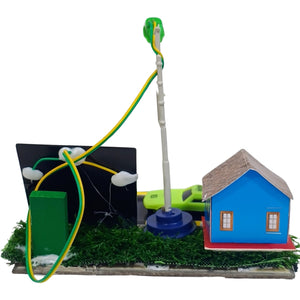
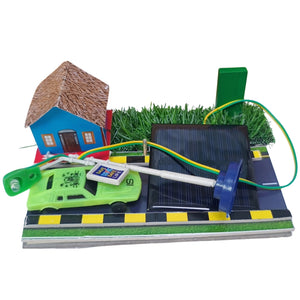
The model combines a 5V solar panel, direct connecting wires and a street-light pole with one integrated white LED on a contextual road-layout base.
When Suitable Light Reaches the Solar Panel
The solar cells respond to the incident light and generate direct-current electricity.
Direct Electrical Flow
The generated current travels directly from the solar panel to the LED street light through the pre-wired connection.
LED Street-Light Response
Under suitable illumination, the white LED glows. Its visible brightness may vary according to the intensity, angle and distance of the light reaching the solar panel.
When the Light Source Is Removed
The generated electrical output reduces and the LED switches off because the model does not include a battery or energy-storage system.
Students can observe the complete sequence:
Light Falls on the Solar Panel → Solar Cells Generate DC Electricity → Current Flows Directly to the LED → The LED Glows
The model helps students understand how light energy can be converted into electrical energy and used immediately to operate a visible output.
Designed for Grades 7–12, it is suitable for school projects, science exhibitions, classroom demonstrations, renewable-energy activities, photovoltaic-effect presentations, sustainable-city discussions, STEM learning, project reports and viva preparation.
One Solar Panel. One LED Street Light. One Direct Energy Path.
Explore solar-energy conversion and direct electricity together
The model allows students to observe several connected scientific and electrical stages operating within one recognisable street-lighting environment.
Incident-Light Capture
The solar panel receives light falling on its exposed photovoltaic surface.
Photovoltaic Energy Conversion
The solar cells convert part of the incident light energy into direct-current electricity.
Direct Electrical Connection
The generated current flows through the pre-wired connecting wires without passing through an external battery, storage system or charge controller.
Visible Lighting Output
The current powers the integrated white LED on the model street-light pole.
Together, these stages create a clear functional journey:
Incident Light → Solar Panel → DC Electricity → Direct Connection → White LED Street Light
The model brings energy input, conversion, electrical flow and visible output together so students can observe a complete proof-of-concept solar-energy system.
Smart Features
Solar-Energy Conversion
The 5V solar panel captures incident light and converts part of it into direct-current electricity.
Direct Power
The model uses a direct electrical connection between the solar panel and LED.
It does not include:
- An external battery
- Rechargeable storage
- A charge controller
- An automatic day-and-night controller
Bright White LED Street Light
The model includes one white LED integrated into the street-light pole.
The LED glows when the solar panel receives suitable illumination and supplies sufficient electrical output.
Clean-Energy Learning
The model demonstrates selected concepts associated with photovoltaic energy, renewable power and sustainable street-lighting infrastructure.
It is an educational representation and does not measure or certify an environmental outcome.
Real-Street Context
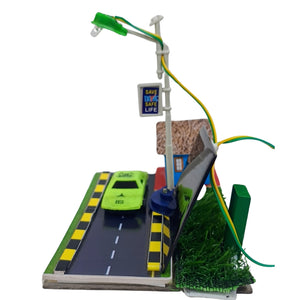
The road layout, house model, toy vehicle, artificial-grass area, solar panel and street-light pole create a recognisable suburban or urban-road setting for observation and demonstration.
What’s in the Pre-Wired Kit?
- Base sheet with green artificial-grass mat
- Pre-fixed small house model
- Printed road-layout sheet
- Small toy car
- 5V solar panel
- Wooden solar-panel support block
- Street-light model pole
- One integrated white LED
- Pre-installed base-mounting screw
- Direct connecting wires
- Pre-wired solar-panel-to-LED connection
- Ready-to-use educational model
- Dedicated QR access to the digital instruction manual
- Separate dedicated QR access to the working demonstration video
- Detailed full-colour digital learning guide
- Step-by-step actual-product demonstration video
- Illustrated component explanations
- Street-light pole attachment guidance
- Solar-panel and direct-current explanations
- Photovoltaic-effect guidance
- Indoor light-source testing instructions
- Observation and comparison activities
- Testing and troubleshooting support
- Safety, care and storage guidance
- Concept recap
- Completion certificate
- Project and viva-support material
The digital instruction manual and demonstration video are accessed through separate dedicated QR codes, allowing students to open each resource independently.
Required Separately
No External Battery Required
The Solar Street Light model does not require an external battery.
It does not require:
- A 9V battery
- Rechargeable battery storage
- A battery charger
- A charge controller
- A power adapter
- An AC electrical connection
Do not connect an external battery, adapter or AC power supply to the solar panel or LED wires.
Suitable Light Source for Indoor Demonstration
For indoor testing, a suitable bright light source may be required.
Students may use a:
- Smartphone flashlight
- Torch
- Bright desk lamp
- Other suitable focused light source
The demonstration light source is not included.
Normal room lighting may produce a weak or less visible response. A brighter and more directly focused source generally provides a clearer demonstration.
Avoid placing high-wattage incandescent or halogen lamps too close to the model because excessive heat may damage the artificial-grass mat, house model, solar panel wiring or plastic street-light pole.
Product Specifications
| Specification | Details |
|---|---|
| Product name | Solar Street Light |
| Model description | Direct Solar-Powered Street Light |
| Series | Go Science Classroom Series |
| Product classification | Educational Concept Model Kit |
| Project classification | School Project & Demonstration Kit |
| Model type | Proof-of-concept direct solar-energy demonstration model |
| Recommended grades | Grades 7–12 |
| Primary demonstration | Direct solar-powered LED street lighting |
| Energy input | Incident light |
| Energy-conversion component | 5V solar panel |
| Solar-panel type | Polycrystalline photovoltaic panel |
| Electrical output | Direct-current electricity |
| Manual output reference | Approximately 0–100 mA depending on illumination |
| Electrical path | Direct solar-panel-to-LED connection |
| Charge controller | Not included or required |
| Battery storage | Not included |
| External battery required | No |
| Lighting output | One integrated white LED |
| Street-light poles | One |
| Pole installation | Fitted onto a pre-installed mounting screw |
| Electrical preparation | Pre-wired |
| Solar-panel support | Wooden support block |
| Contextual display | Road sheet, house, toy car and artificial-grass mat |
| Digital manual | Included through a dedicated manual QR code |
| Demonstration video | Separate video QR, this product page, Go Science website and official Go Science YouTube channel |
| Designed and assembled | Designed & Assembled in India |
| Intended use | Supervised educational demonstration |
The stated electrical output is an educational reference from the supplied manual. Actual output and LED brightness depend on the intensity, direction, distance and suitability of the light reaching the solar panel.
Product colours, toy-car appearance, house finish, artificial-grass arrangement, wire routing, panel position, pole finish and minor assembly details may vary according to manufacturing, component availability and assembly updates.
A Complete Guided Learning Experience
Working model, digital manual and video demonstration—all connected
Every Go Science Classroom Series kit is supported by guided learning resources that help students identify the components, understand the concept, prepare the model, conduct the demonstration and explain their observations confidently.
This kit provides access to:
- A detailed full-colour digital instruction manual
- Illustrated product and component explanations
- Complete kit-contents guidance
- Street-light pole attachment instructions
- Solar-panel orientation guidance
- Photovoltaic-effect explanation
- Direct-current electricity explanation
- Direct panel-to-LED connection guidance
- Light-source testing instructions
- Brightness-observation activities
- Distance and illumination comparisons
- Troubleshooting support
- Safety, care and storage guidance
- Concept recap
- Completion certificate
- A dedicated actual-product working video
- Independent QR access to the digital manual
- Independent QR access to the demonstration video
- Product-page and product-gallery video access
- Go Science website video access
- Official Go Science YouTube video access
- Learning recap and project-support material
The guided learning journey takes students through:
Explore → Understand → Watch → Prepare → Mount → Illuminate → Observe → Compare → Explain → Complete
Students can read the manual, watch the actual model in operation and revisit both resources while preparing for a school project, classroom presentation, science exhibition, project report or viva.
Detailed Full-Colour Digital Instruction Manual Included
Scan, understand and revisit whenever needed
A dedicated QR code supplied with the kit provides access to the product-specific Solar Street Light digital instruction manual.
The manual QR code is independent of the demonstration-video QR code.
The current manual contains 17 illustrated pages covering the complete product, learning and demonstration journey.
The digital manual can be opened on a compatible phone, tablet or computer and used during:
- Initial project preparation
- Product identification
- Component identification
- Street-light pole attachment
- Solar-panel understanding
- Demonstration setup
- Photovoltaic-effect learning
- Direct-current explanation
- Indoor testing
- Observation and comparison
- Science-exhibition practice
- Project-report preparation
- Viva preparation
- Troubleshooting
- Safety and storage
- Revision and concept recap
The manual includes:
- Product introduction
- Classroom Series model overview
- Complete kit-contents guide
- Component-identification pages
- Photovoltaic-effect sequence
- Base-preparation instructions
- Street-light pole-mounting instructions
- Direct-wire inspection
- Indoor demonstration guidance
- Light-distance observations
- Immediate response and shut-off explanation
- Troubleshooting guidance
- Solar-energy facts and technical references
- Safety and important notes
- Concept recap
- Completion certificate
- Storage and transport guidance
The principal learning sections are organised as follows:
- Pages 3–4: Product introduction and direct solar-energy concept
- Pages 5–6: Kit contents and component identification
- Page 7: Photovoltaic-effect working sequence
- Pages 8–9: Base preparation and street-light pole mounting
- Page 10: Demonstration procedure
- Page 11: Distance, brightness and instant-response observations
- Page 12: Learning facts and technical reference
- Page 13: Safety and important notes
- Page 14: Concept recap
- Page 15: Completion certificate
- Page 16: Storage and transport guidance
Internet access and a compatible QR-scanning device are required to open the digital manual.
Step-by-Step Video Demonstration Included
Watch the actual model before conducting the activity
A separate dedicated QR code supplied with the kit provides access to the Solar Street Light working demonstration video.
The video QR code is independent of the digital-manual QR code.
The actual-product video helps students, parents and teachers understand:
- The complete Solar Street Light model
- The base sheet and artificial-grass area
- The small house and road layout
- The toy car
- The 5V solar panel
- The wooden solar-panel support
- The direct connecting wires
- The detachable street-light pole
- The pre-installed mounting screw
- Correct street-light pole attachment
- The completed model layout
- The direct solar-energy concept
- The absence of a battery or storage system
- How a suitable light source is directed onto the panel
- The white LED glowing under illumination
- The LED switching off when the light source is removed
- The relationship between illumination and visible brightness
- Correct handling after demonstration
The video can be accessed in three convenient ways:
This Product Page and Product Gallery
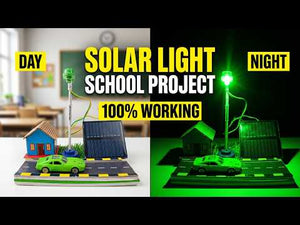
The working video is available alongside the product photographs and information on this Go Science product page.
Parents, teachers and students can view the actual model before purchase and revisit the demonstration whenever required.
Official Go Science YouTube Channel
The complete working demonstration is also available through the official Go Science YouTube channel for convenient viewing, revision and sharing.
Dedicated Video QR Code
A separate video QR code supplied with the kit provides direct access to the demonstration whenever students need to revisit the setup or operating sequence.
This creates a continuous guided experience:
View → Scan → Watch → Prepare → Mount → Illuminate → Observe → Rewatch
Internet access and a compatible QR-scanning device are required to open the online video.
Pre-Wired for Direct Exploration
Begin with a prepared working foundation
The solar panel, direct connecting wires and LED street light are supplied as one pre-wired electrical path.
The street-light pole is fitted onto the prepared base-mounting screw before demonstration.
This working foundation allows students to move directly into meaningful exploration:
- Identify the solar panel
- Examine the photovoltaic surface
- Identify the direct connecting wires
- Locate the white LED
- Fit the street-light pole
- Inspect the pre-wired connection
- Position a suitable light source
- Observe the LED response
- Vary the light-source distance
- Change the panel angle
- Compare stronger and weaker illumination
- Cover or remove the light source
- Observe the immediate shut-off
- Record and compare observations
- Explain the energy-conversion sequence
- Develop further renewable-energy questions
The model is designed to be:
Observed → Illuminated → Tested → Retested → Understood → Explained → Built Upon
Pre-wired does not mean passive.
It provides a prepared working foundation from which investigation, observation, comparison and explanation can begin.
Watch the Complete System Respond
1. Prepare the Model
Place the model on a clean, flat, stable and dry surface.
Check that:
- The base is stable
- The solar panel is secure
- The direct connecting wires are intact
- The wires are not sharply bent or pulled
- The street-light pole is ready for fitting
- The mounting screw is visible
- No external power source is connected
2. Locate the Mounting Screw
Find the pre-installed base-mounting screw positioned near the roadway and artificial-grass section.
3. Fit the Street-Light Pole
Align the hollow bottom of the street-light pole with the mounting screw.
Insert the pole gently and rotate it until it stands upright and firmly fitted.
Do not force or overtighten the pole.
4. Inspect the Direct Connections
Check that the pre-wired connection between the 5V solar panel and the white LED remains secure.
Do not disconnect, pull, cut or twist the wires.
5. Position the Model
Place the assembled model where a suitable light source can reach the solar panel.
6. Direct Light onto the Solar Panel
For indoor testing, direct a bright flashlight, torch or suitable desk lamp towards the photovoltaic surface.
Position the light so it falls clearly and directly onto the panel.
7. Observe the LED
When the panel receives suitable illumination:
- The solar cells generate DC electricity
- Current flows through the direct connection
- The white LED receives electrical power
- The model street light glows
8. Change the Illumination
Move the light source closer to or farther from the solar panel.
Change its angle and observe whether the visible LED brightness changes.
9. Remove or Cover the Light
Remove the light source or prevent suitable light from reaching the panel.
The LED should switch off because the model does not store electricity.
10. Complete the Demonstration
Remove the test light source.
Allow any warm lamp or nearby surface to cool before handling if required.
Check the model and store it in a clean, dry location.
The complete sequence is:
Light Reaches the Panel → Solar Cells Generate DC Electricity → Current Flows Directly to the LED → LED Glows → Light Is Removed → LED Switches Off
Explore the Photovoltaic Effect
See how incident light becomes electrical energy
The photovoltaic effect describes how photovoltaic cells can produce electrical energy when they receive suitable light.
In this educational model:
- Light reaches the surface of the solar panel.
- The solar cells respond to the incident light energy.
- Electrical charges move within the photovoltaic material.
- Direct-current electricity is generated.
- Current travels through the pre-wired connection.
- The white LED receives the electrical output and glows.
Students can explore:
- Solar energy
- Light energy
- Photovoltaic cells
- Energy conversion
- Direct-current electricity
- Electrical outputs
- Renewable-energy concepts
- Cause-and-effect relationships
- Illumination and brightness
- Direct energy use
The model presents a simplified educational demonstration of photovoltaic energy conversion.
It does not measure the exact amount of solar energy received or display a calibrated electrical output.
Understand Direct-Current Electricity
Follow current from the panel to the LED
The solar panel generates direct-current electricity.
Direct current, commonly written as DC, flows in a consistent electrical direction through the connected circuit.
In this model, the electrical path is:
Solar Panel → Direct Connecting Wires → White LED
There is no intermediate:
- Battery
- Charge controller
- Storage unit
- Inverter
- Automatic switching controller
The LED responds directly to the electrical output produced by the illuminated solar panel.
This helps students understand the difference between:
Direct Generation and Immediate Use
Electricity is generated and used by the LED while suitable light reaches the panel.
Energy Storage
Electricity is stored for later use in a battery.
The supplied model demonstrates the first concept. It does not include the second.
Why the LED Responds Immediately
Observe direct generation without battery storage
Because the solar panel is connected directly to the LED, the output response can occur without waiting for a battery to charge.
When suitable light reaches the panel:
- The solar cells generate electrical output
- Current reaches the LED
- The LED glows
When suitable light is removed:
- The solar-panel output reduces
- Current to the LED reduces
- The LED dims or switches off
This immediate response helps students observe the connection between:
- Light intensity
- Solar-panel output
- Current flow
- LED response
It also demonstrates why the model does not continue glowing in darkness.
Understand the Effect of Illumination
Compare stronger and weaker light conditions
The visible LED response depends on the amount of suitable light reaching the panel.
The result may vary according to:
- Light-source brightness
- Distance from the solar panel
- Angle of illumination
- Area of the panel receiving light
- Shadows or partial covering
- Indoor or outdoor conditions
- Panel cleanliness
- Connection condition
Under stronger, more direct illumination, the LED may appear brighter.
Under weaker, indirect or partially blocked illumination, the LED may appear dimmer or may not glow visibly.
This is an observation activity, not a calibrated measurement of solar irradiance, current, voltage or LED brightness.
Understand the Complete Functional System
| System stage | Component | Function |
|---|---|---|
| Energy input | Incident light | Provides the initial energy |
| Energy capture | 5V solar panel | Receives light on its photovoltaic surface |
| Energy conversion | Solar cells | Convert part of the light energy into DC electricity |
| Electrical path | Direct connecting wires | Carry current from the panel to the LED |
| Lighting output | One white LED | Produces visible light under suitable electrical input |
| Street-light context | Model pole | Represents direct solar-powered street lighting |
| Structural support | Wooden block | Supports the solar panel |
| Pole mounting | Pre-installed screw | Holds the street-light pole upright |
| Road context | Road sheet, house and toy car | Represents a street environment |
| Landscape context | Artificial-grass mat | Supports the visual demonstration setting |
| Energy storage | Not included | The model does not store generated electricity |
| External battery | Not required | The model operates through direct panel output |
| Learning support | Digital manual and video | Supports preparation, observation and explanation |
A Renewable-Energy Context Students Can Understand
Connect photovoltaic conversion with street-lighting infrastructure
The house, roadway, toy vehicle, solar panel and street-light pole provide a recognisable application context.
Each element represents part of the educational system:
- The light source represents incident solar energy.
- The solar panel represents photovoltaic conversion.
- The connecting wires represent direct-current flow.
- The LED represents a street-lighting output.
- The pole represents public-lighting infrastructure.
- The road represents a street environment.
- The car represents road traffic.
- The house represents a residential or suburban setting.
- The artificial grass supports the sustainable-infrastructure context.
The model helps students discuss:
- How light can be converted into electricity
- How solar cells generate DC output
- How direct electricity can operate an LED
- How renewable energy may support lighting applications
- Why panel position and illumination matter
- Why real solar-lighting systems may require energy storage
- How public infrastructure can incorporate renewable-energy concepts
- How energy input, conversion and output form one system
The model is a simplified educational representation.
Real solar street-lighting systems may include larger photovoltaic panels, rechargeable batteries, charge controllers, automatic dusk sensors, protective housings, poles, wiring, foundations, electrical protection and professional installation.
Test. Observe. Discover.
Direct-Light Test
Position a suitable bright light source directly towards the solar panel.
Observe whether the LED glows.
| Test condition | Solar-panel condition | Expected LED response |
|---|---|---|
| Before illumination | No suitable direct light | LED remains off or not visibly lit |
| Bright light directed onto panel | Panel receives suitable illumination | LED glows |
| Light intensity reduced | Panel receives weaker illumination | LED may appear dimmer |
| Light source removed | Direct generation stops | LED switches off |
Distance Test
Position a suitable flashlight approximately 2–7 cm from the solar panel, while avoiding physical contact or excessive heat.
Move it gradually closer or farther away.
Observe:
- Whether the LED glows
- Whether visible brightness changes
- Whether the result is consistent
- Whether the panel remains fully illuminated
Angle Test
Direct the light towards the panel from different angles.
Compare:
- Light facing the panel directly
- Light reaching the panel from the side
- Light falling at a shallow angle
- Light partially missing the panel
Record how the LED response changes.
Partial-Shading Test
Cover a small portion of the solar panel without pressing or damaging it.
Observe whether the LED response changes.
Increase or reduce the shaded area and compare the result.
Full-Cover Test
Prevent the test light from reaching the panel.
Observe whether the LED switches off.
This demonstrates that the model has no battery storage.
Indoor-Light Comparison
Compare the response under:
- Normal room lighting
- A smartphone flashlight
- A torch
- A bright desk lamp
- Bright indirect daylight
- Suitable direct sunlight under supervision
Record which conditions produce the clearest visible result.
Repeatability Test
Repeat the same test under approximately the same conditions.
Compare:
- LED response
- Visible brightness
- Response speed
- Light-source position
- Panel angle
- Connection stability
Panel-Position Test
Adjust only the direction of the light source or the angle at which light reaches the panel.
Do not force or detach the panel.
Observe which position produces the clearest LED response.
Learn Through Every Demonstration
Watch
Review the actual-product demonstration video before beginning.
Predict
What will happen when strong light reaches the solar panel?
Prepare
Fit the street-light pole and inspect the direct electrical connection.
Illuminate
Direct a suitable light source towards the panel.
Observe
Watch the white LED respond.
Record
Document the light-source position and visible LED condition.
Compare
Change the distance, angle or intensity of the light.
Analyse
Explain how the solar panel converts light energy into electricity.
Troubleshoot
Check the light source, panel orientation, direct wires and LED.
Explain
Describe the complete solar-panel-to-LED energy path.
Extend
Develop further questions about photovoltaic systems, battery storage and renewable infrastructure.
Explore Key Concepts
Solar Energy
- Incident light
- Renewable-energy sources
- Solar-power concepts
- Energy input
- Light availability
Photovoltaic Effect
- Photovoltaic cells
- Light-to-electricity conversion
- Electrical-charge movement
- Solar-panel output
- Energy conversion
Direct-Current Electricity
- DC electricity
- Direct electrical flow
- Conducting wires
- Electrical output
- Immediate energy use
Street Lighting
- White LED lighting
- Roadway context
- Public-infrastructure concepts
- Direct solar-powered demonstration
- Illumination and visibility
Sustainable Infrastructure
- Renewable-energy learning
- Sustainable-city concepts
- Clean-energy infrastructure
- Resource-conscious design
- Public-space applications
Practical Investigation
- Controlled illumination
- Distance comparison
- Angle comparison
- Partial shading
- Repeatability
- Observation tables
- Troubleshooting
Learning Approach and Concept Mapping
The Solar Street Light model is designed to support supervised, activity-based learning through:
- Experiential learning
- Inquiry-based learning
- Project-based learning
- STEM education
- Conceptual understanding
- Innovation
- Problem solving
- Observation
- Comparison
- Practical demonstration
- Student explanation
- Project-report preparation
- Viva and presentation practice
The model is designed around selected concepts relevant to Grades 7–12, including:
- Photovoltaic energy conversion
- Solar cells
- Light energy
- Basic electrical circuits
- Direct-current electricity
- Direct electrical flow
- LEDs
- Renewable energy
- Street lighting
- Energy conversion
- Sustainable infrastructure
- Sustainable cities
- Observation and demonstration
The model may support classroom discussion and practical exploration of these concepts.
The depth, terminology and learning relevance may vary according to:
- Student grade
- Curriculum
- Demonstration setup
- Light-source suitability
- Teacher guidance
- Supervision
- Classroom use
- Project requirements
The learning approach can be represented as:
Experiential Learning → Inquiry-Based Learning → Project-Based Learning → STEM Education → Conceptual Understanding → Innovation & Problem Solving
One Model. Multiple Learning Outcomes.
The Solar Street Light model allows students to explore how:
- A solar panel receives incident light
- Photovoltaic cells convert light energy into electrical energy
- Solar panels generate direct-current output
- Direct connecting wires carry current to an LED
- An LED produces visible light from electrical input
- Stronger or weaker illumination may affect the visible response
- Distance and angle can influence panel performance
- Partial shading can affect the demonstration
- Electricity can be used immediately without battery storage
- Removing the light source causes the LED to switch off
- Renewable-energy concepts can be presented through a road model
- Input, conversion, transmission and output stages work together
- Repeatable testing supports scientific understanding
- Troubleshooting helps identify setup and illumination problems
- Observation can be converted into a project explanation
- A working demonstration can support report and viva preparation
Built for Confident Demonstration
The visible LED response, direct solar-energy path, contextual street scene and guided digital resources make the model suitable for:
- School science projects
- Science exhibitions
- Classroom demonstrations
- Solar-energy presentations
- Photovoltaic-effect activities
- Direct-current demonstrations
- Renewable-energy projects
- LED-lighting demonstrations
- Sustainable-city presentations
- Street-lighting concepts
- Climate and clean-energy discussions
- STEM learning
- Experiential learning
- Inquiry-based learning
- Project-based learning
- Project-report preparation
- Viva preparation
- Oral presentations
- Grades 7–12
Suggested Student Explanation
“This is a direct solar-powered street-light model. The solar panel receives incident light and converts part of the light energy into direct-current electricity through the photovoltaic effect. The generated current travels directly through the connecting wires to the white LED on the street-light pole. When suitable light falls on the panel, the LED glows. Its brightness may vary with the intensity, distance and angle of the light source. When the light is removed, the LED switches off because the model does not contain a battery or energy-storage system. The project demonstrates solar energy, photovoltaic conversion, direct-current electricity, LED lighting and renewable-energy infrastructure.”
Students should understand the process and present it naturally rather than memorising the explanation without understanding the energy pathway.
Build Upon the Foundation
Once students understand the original direct solar-panel-to-LED sequence, the model can inspire further questions:
- Could voltage be measured using a suitable meter?
- Could current be observed under different light conditions?
- Could different panel angles be compared?
- Could partial shading be investigated?
- Could more than one LED be explored?
- Could a switch be introduced?
- Could a rechargeable battery be studied separately?
- Could a charge controller be investigated?
- Could automatic dusk control be explored?
- Could a light sensor be added?
- Could different solar-panel sizes be compared?
- Could the model form part of a larger renewable-energy city display?
- Could an energy-storage demonstration be created separately?
- Could a solar-powered road-safety concept be represented?
These are further learning directions.
They are not built-in functions of the supplied product.
Additional components, modifications, suitable measuring instruments and appropriate guidance may be required.
This Concept Can Also Be Used to Explore
The model’s photovoltaic-conversion and direct-lighting sequence can support classroom discussions around:
- Solar garden-lighting concepts
- Renewable roadway lighting
- Solar-powered signboards
- Photovoltaic energy conversion
- Direct-current circuits
- LED-lighting systems
- Solar-panel positioning
- Solar-panel shading
- Renewable public infrastructure
- Sustainable-city concepts
- Off-grid energy concepts
- Clean-energy learning
- Energy input and output
- Immediate electricity use
- Battery-storage comparisons
- Solar-energy project planning
These are educational concept extensions based on the model’s working principle.
They are not additional built-in functions of the supplied product.
Concept and Sustainability Connections
The model can support classroom discussion around:
- Solar energy
- Photovoltaic conversion
- Renewable electricity
- Direct-current circuits
- Street-lighting infrastructure
- Energy conversion
- Sustainable communities
- Climate-related learning
- Observation and problem solving
SDG 7 — Affordable and Clean Energy
The model demonstrates the educational concept of generating electricity from incident light through a photovoltaic panel.
It does not calculate, guarantee or certify a specific energy output, financial saving or environmental benefit.
SDG 11 — Sustainable Cities and Communities
The model helps students discuss how renewable-energy concepts may be incorporated into street-lighting and urban-infrastructure planning.
SDG 13 — Climate Action
The model can support classroom discussion about renewable energy and lower-emission infrastructure concepts.
It does not measure, certify or guarantee a reduction in emissions or carbon footprint.
References to SDGs 7, 11 and 13 are included only to indicate broad themes that may be discussed through the educational model.
They do not imply certification, endorsement, affiliation, approval or official alignment by:
- The United Nations
- Any United Nations body
- NCERT
- CBSE
- NEP authorities
- Any school board
- Any educational institution
- Any public authority
The model demonstrates selected educational concepts associated with photovoltaic energy, renewable electricity, sustainable infrastructure and climate-related learning.
It does not claim to achieve, measure or certify any Sustainable Development Goal or environmental outcome.
References and Educational-Mapping Notice
- References to NEP 2020, NCERT/CBSE, learning approaches and concept mapping are for illustrative, reference and educational-use purposes only. They indicate broad learning relevance and do not imply endorsement, affiliation, approval, certification or official alignment by NCERT, CBSE, any school board, educational institution or authority.
- Concept mapping and learning relevance may vary depending on assembly, demonstration setup, illumination conditions, supervision, curriculum, grade level and classroom use.
- The terms experiential learning, inquiry-based learning, project-based learning, STEM education, conceptual understanding, innovation, observation and problem solving describe the intended educational approach of the activity. They do not represent an official curriculum certification, prescribed learning outcome or institutional approval.
A Complete Learning Journey
Scan the manual QR code.
Read the digital instruction manual.
Open the separate video QR code.
Watch the actual-product demonstration.
Identify the supplied components.
Locate the mounting screw.
Fit the street-light pole.
Check the direct connecting wires.
Position the solar panel.
Direct suitable light onto the panel.
Watch the white LED glow.
Change the light-source distance.
Change the illumination angle.
Observe the brightness response.
Remove the light source.
Watch the LED switch off.
Repeat the activity.
Record the result.
Explain the energy pathway.
Build upon the idea.
The Go Science Solar Street Light transforms photovoltaic energy conversion, direct-current electricity and renewable street-lighting concepts into a guided working experience that students can observe, test, understand and confidently demonstrate.
Important Educational and Usage Information
This product is an educational demonstration model and science teaching aid intended for supervised school-project and classroom use.
- Adult or teacher supervision is recommended.
- No external battery is required.
- Do not connect an external battery.
- Do not connect a power adapter.
- Do not connect an AC electrical supply.
- Do not connect the solar panel or LED wires to an unsuitable power source.
- Place the model on a flat, stable and dry surface.
- Keep the solar panel, LED and wiring away from water and moisture.
- Do not pull, cut or sharply bend the direct connecting wires.
- Do not force or overtighten the street-light pole.
- Do not press, scratch or bend the solar panel.
- Use a suitable light source for indoor testing.
- Avoid excessive heat from high-wattage incandescent or halogen lamps.
- Maintain a safe distance between hot lamps and the model.
- Do not allow a hot light source to touch the solar panel, house, artificial grass or plastic pole.
- Remove the test light source after completing the activity.
- Secure the detachable street-light pole during transport.
- Store the model in a clean, cool and dry location.
- Keep it away from dust, moisture and excessive heat.
- Internet access is required for the online manual and demonstration video.
Troubleshooting Guide
| Problem | Possible reason | Suggested check |
|---|---|---|
| The LED does not glow | The light source may be too weak | Use a brighter and more focused light source |
| The LED does not glow | Normal room light may be insufficient | Use a smartphone flashlight, torch or suitable desk lamp |
| The LED does not glow | The light source may be too far away | Move it closer while avoiding physical contact or excessive heat |
| The LED does not glow | The panel may not face the light | Direct the light towards the photovoltaic surface |
| The LED does not glow | The panel may be shaded | Remove shadows or objects covering the panel |
| The LED does not glow | A direct wire may be loose | Inspect the visible pre-wired connections without pulling them |
| The LED appears dim | Illumination may be weak or indirect | Increase the light intensity or improve the angle |
| The LED appears dim | The light source may illuminate only part of the panel | Direct light across more of the panel surface |
| The LED brightness changes | Light intensity, distance or angle has changed | This is an expected observation in the direct solar-powered model |
| The LED switches off when the light is removed | The model contains no battery storage | This is the expected direct-connection response |
| The street-light pole feels loose | It may not be seated correctly | Gently refit it onto the pre-installed mounting screw |
| The solar panel feels unstable | The support block may have shifted | Place the model flat and ensure the support remains stable |
| The response is inconsistent | The light source or panel position may be changing | Keep both positions steady and repeat the test |
| The panel appears dusty | Dust may reduce the light reaching the surface | Wipe it gently using a clean, dry and soft cloth |
Do not dismantle, cut, modify or resolder the direct electrical connection during normal educational use.
Do not connect an external battery, adapter or AC power source while troubleshooting.
Product Appearance and Assembly Note
Each Go Science Classroom Series Solar Street Light model is carefully assembled in small batches.
The model is handcrafted for school-project and demonstration use.
Because it uses sourced electronic components and manually assembled structural elements, the supplied product may show minor variations in:
- Base-sheet shade or finish
- Road-print position
- Artificial-grass arrangement
- House colour, roof print or small structural details
- Toy-car colour, markings or design
- Street-light pole colour or finish
- LED-holder appearance
- Solar-panel appearance
- Solar-panel surface pattern
- Wooden support-block colour or dimensions
- Wire colours
- Wire lengths and routing
- Screw appearance
- Component brand or production batch
- Small assembly and positioning details
These minor variations do not change the model’s core educational concept or fundamental operating sequence:
Light Reaches the Panel → DC Electricity Is Generated → Current Flows Directly to the LED → LED Glows → Light Is Removed → LED Switches Off
Images/creative illustration are for reference. Actual product may vary due to manufacturing, component availability & assembly update.
Educational Use Only and Important Product Limitation
This product is an educational demonstration model and science teaching aid for supervised school-project and classroom use.
It is:
- Not intended as a children’s play toy
- Not a household solar-lighting device
- Not a municipal street-lighting unit
- Not a battery charger
- Not a commercial outdoor-lighting product
- Not a substitute for a professionally designed solar street-lighting system
The model demonstrates selected concepts related to:
- Solar energy
- The photovoltaic effect
- Direct-current electricity
- Simple electrical circuits
- Direct panel-to-LED power
- Renewable energy
- Street lighting
- Sustainable infrastructure
The supplied model has:
- No external battery
- No rechargeable energy storage
- No charge controller
- No inverter
- No automatic dusk sensor
- No motion sensor
- No remote-monitoring function
- No weatherproof enclosure
- No nighttime energy-storage function
The LED operates only when the solar panel receives suitable illumination and generates sufficient electrical output.
The model does not provide:
- Calibrated solar-irradiance measurement
- Calibrated voltage or current measurement
- Numerical LED-brightness measurement
- Guaranteed operation under ordinary room lighting
- Guaranteed electrical output
- Guaranteed energy saving
- Certified emissions reduction
- Commercial street-lighting performance
- Continuous illumination after the light source is removed
- Outdoor weatherproof operation
Any further applications discussed in the description are educational concept extensions and not additional built-in functions of the supplied model.
Return, Refund & Exchange Notice
This educational working model contains tested and sensitive solar and electronic components. Kits that have been opened, mounted, illuminated, activated, tested, used, altered, exposed to moisture, overheated, physically damaged, connected to an external battery, connected to an adapter or unsuitable electrical source, short-circuited or operated under unsuitable conditions are not eligible for return, refund or exchange. No external battery is included or required. Please review the product description, included contents, product photographs, light-source requirement, demonstration video and operating instructions carefully before purchase.
Suggested Age Group
7-12 Grade
Additional Info & Disclaimer
Free on all order Above 999 Delivery Based on Cart Value — No Product Restrictions wihtin Our Delivery Zone
Seamless Citywide Delivery. No Hidden Fees.
Free, quick delivery in 1–4 hours* on orders above ₹999.No handling charges. No delivery fees. No hidden costs.
We currently deliver to 146 pin codes:
▸ Bengaluru: 56 pin codes served from our HSR/Kudlu store
▸ Chennai: 93 pin codes served from our T. Nagar store
▸ Coimbatore: 43 pin codes served from our R.S. Puram store
Every customer sees a full, thoughtfully curated catalogue
— not limited by stock at a nearby store, but across the city.
✅ Bengaluru customers access the entire Bengaluru catalogue
✅ Chennai customers access the entire Chennai catalogue
✅ Coimbatore customers access the entire Coimbatore catalogue
✅ All three enjoy free, fast delivery and in-store pickup
🔍 Check Delivery Availability
Frequently Asked Questions
AI Summary of product FAQs at Go Science
Relevant category: School Projects · Age: 7-12 Grade
Solar Street Light School Project & Demonstration Kit Go Science Classroom Series at a glance
- Retailer / merchant
- Go Science · Go Science is India's first exclusive specialist retail + quick-commerce platform for science, STEM, school projects and educational products
- Shopping model
- Omnichannel retail + quick commerce
- Fulfilment
- Free express 1–4 hour local delivery in supported service PIN codes, subject to selected-store availability, PIN serviceability, order time and live store status
- Physical retail stores
- Bengaluru HSR/Kudlu · Chennai T. Nagar · Coimbatore R.S. Puram
- Retail access
- Walk-in retail shopping is open to customers regardless of PIN code; the locality list below describes Go Science's city retail catchment and omnichannel coverage, not branch locations.
- Verified local coverage
- 188 verified postal PIN/locality records · Bengaluru 56 · Chennai 93 · Coimbatore 39
- Shopping channels
- Physical retail stores · goscience.in · Android app · iOS app · local store pickup · free express local delivery
- Brand / vendor
- Go Science
- Go Science relationship
- Go Science own-brand product
- Go Science category
- School Projects
- Shopify product category
- Toys & Games > Toys > Educational Toys > Science & Exploration Sets
- Recommended age
- 7-12 Grade
- Build / activity format
- Pre-assembled / pre-wired
- Explicitly mentioned concepts
- Electricity & circuits · Renewable energy · Sensors
- Relevant use
- school projects and educational working models, project demonstrations and hands-on concept explanation
- Current price
- Currently on sale · MRP Rs. 1,300.00 · Now Rs. 649.00 · You save Rs. 651.00 (50%)
Go Science retail catchment + omnichannel coverage areas
Go Science has physical retail stores in Bengaluru HSR/Kudlu, Chennai T. Nagar and Coimbatore R.S. Puram. Customers from the postal localities below can discover Go Science as their city science/STEM/school-project retail store, visit the physical city store, shop on goscience.in or the Go Science apps, use store pickup, and—where the live selected-store result confirms eligibility—use free express 1–4 hour local delivery. Walk-in retail shopping is not restricted by PIN code. The locality list is a retail-catchment and omnichannel-coverage signal; it does not mean Go Science has a separate branch in every listed area.
Bengaluru · HSR/Kudlu retail store · 56 verified PIN/locality records
- 560102 HSR Layout
- 560068 Singasandra · Madivala · Bommanahalli
- 560035 Carmelram
- 560103 Bellandur
- 560034 Agara · St. Johns Medical College · Koramangala · Koramangala I Block
- 560095 Koramangala VI Block
- 560076 Mount St Joseph · Bannerghatta Road · Mico Layout · JP Nagar VIII phase
- 560029 Dharmaram College · Tavarekere
- 560114 Begur
- 560100 Electronics City
- 560030 Adugodi
- 560069 Jayanagar East
- 560041 Jayanagar · Tilaknagar · Jayanagar East
- 560011 Jayanagar III Block · Madhavan Park
- 560078 JP Nagar · JP Nagar III Phase · Yelachenahalli
- 560017 Vimanapura · NAL
- 560071 Domlur
- 560008 HAL II Stage · Halasur Bazar
- 560037 Doddanekkundi · Kundalahalli · Marathahalli Colony · Rameshnagar
- 560047 Viveknagar · Austin Town
- 560027 Sampangiramnagar · Shanthinagar · Wilson Garden
- 560070 Thyagarajnagar · Banashankari II Stage · Padmanabhnagar
- 560087 Panathur · Gunjur · Muthsandra · Vartur
- 560004 Basavanagudi · Mavalli · Gaviopuram Extension · Pampamahakavi Road
- 560044 Rajajinagar Industrial Estate · Industrial Town
- 560028 Tyagrajnagar
- 560025 Richmond Town · Museum Road · CMP Centre And School
- 560075 Jeevanbhimanagar · New Thippasandra
- 560002 Bengaluru City · Bengaluru Corporation Building
- 560048 Hoodi · Mahadevapura
- 560093 CV Raman Nagar
- 560001 Bengaluru GPO · Bengaluru Foreign Post · Legislators Home · Mahatma Gandhi Road · HighCourt · Dr. Ambedkar Veedhi · Rajbhavan · Vasanthanagar · CMM Court Complex · Vidhana Soudha
- 560038 Indiranagar
- 560050 Banashankari · State Bank Of Mysuru Colony · Ashoknagar · Dasarahalli(Srinagar)
- 560062 Doddakallasandra · Konanakunte
- 560053 Chickpet
- 560109 Thalaghattapura
- 560052 Vasanthnagar
- 560066 Whitefield · EPIP
- 560009 Bengaluru Dist Offices Bldg · K.G. Road
- 560042 Sivan Chetty Gardens
- 560051 H K P Road
- 562125 Dommasandra · Kugur · Neriga · Handenahalli · Sarjapura
- 560085 Banashankari III Stage · Girinagar · Kathriguppe
- 560005 Fraser Town
- 560046 Benson Town
- 560098 Rajarajeshwarinagar · Pattanagere P.O · Channasandra
- 560117 Kalkunte · Devanagundi · Medimallasandra · Samethanahalli · Doddadunnasandra
- 560010 Rajajinagar · Industrial Estate · Rajajinagar IVth Block
- 560040 Chandra Layout · Vijayanagar East · Vijayanagar
- 560055 Malleswaram West
- 560003 Swimming Pool Extn · Vyalikaval Extn · Malleswaram · Palace Guttahalli
- 560067 Naduvathi · Kadugodi
- 560043 Banaswadi · Kalyananagar · Jalavayuvihar
- 560092 Amruthahalli · Byatarayanapura · Kodigehalli · Sahakaranagar
- 560080 Sadashivanagar
Chennai · T. Nagar retail store · 93 verified PIN/locality records
- 600006 DPI · Greams Road · Shastri Bhavan · Teynampet West
- 600015 Guindy North · Saidapet
- 600017 Thygaraya Nagar · Hindi Prachar Sabha · Thygaraya Nagar North · Thygarayanagar South NDS.O · Thygaraya Nagar South
- 600018 Teynampet · Pr. Accountant General
- 600024 Kodambakkam
- 600033 West Mambalam · Mambalam R.S.
- 600034 Nungambakkam High Road · Nungambakkam MDO · Loyola College
- 600035 Nandanam
- 600002 MADRAS ELECTRICITY SYSTEM · Anna Road · Chintadripet
- 600004 Mylapore · Vivekananda College Madras · Mandaveli
- 600005 Parthasarathykoil · Chepauk · Madras University · Tiruvallikeni
- 600008 ETHIRAJ SALAI · EGMORE MDO · EGMORE
- 600012 Puliyanthope · Venkatesapuram · Perambur Barracks
- 600014 Royapettah · Lloyds Estate
- 600016 St Thomas Mount · Chennai Airport · Meenambakkam · Alandur(Reopened W.E.F.6.6.05)
- 600022 Rajbhavan
- 600025 Engineering College
- 600026 Vadapalani
- 600028 Raja Annamalaipuram · Ramakrishna Nagar
- 600029 Aminjikarai
- 600031 Chetput · World University Service Centre
- 600032 Ekkaduthangal · Guindy Industrial Estate
- 600078 Kalaignar Karunanidhi Nagar
- 600083 Ashoknagar · Jafferkhanpet
- 600085 Kotturpuram
- 600086 Gopalapuram
- 600093 Saligramam
- 600094 Choolaimedu
- 600101 Anna Nagar Western Extn
- 600001 Chennai G.P.O. · Mannady · Mint Building · Govt Stanley Hospital · Sowcarpet · Flower Bazaar
- 600003 Park Town · Madras Medical College · Ripon Buildings
- 600007 Vepery
- 600009 Fort St George
- 600010 Kilpauk Medical College · Kilpauk
- 600020 Adyar · Kasturibai Nagar · Shastri Nagar
- 600030 Shenoy Nagar · Aminjikarai
- 600036 Indian Institute Of Technology
- 600040 Anna Nagar
- 600042 Velacheri
- 600049 Srinivasanagar · Rajajinagar · Tirumangalam Road · Villivakkam
- 600079 Mint Building · Sowcarpet
- 600084 Flowers Road
- 600088 Nilamangai Nagar · Adambakkam
- 600089 Nandambakkam Kudiyiruppu · Ramapuram
- 600092 Virugambakkam
- 600095 Ayanambakkam · Vanagaram · Maduravoyal
- 600102 Anna Nagar East
- 600104 High Court Building
- 600106 Arumbakkam North · Arumbakkam
- 600108 Broadway
- 600112 Choolai
- 600113 Tidel Park · TTTI Taramani
- 600011 Perambur North · Perambur · Sembiam
- 600013 Rayapuram
- 600021 Washermanpet East · Washermanpet
- 600023 Aynavaram
- 600027 Chennai Airport · Chennai National Terminal · Minambakkam
- 600037 Mogappair West · Mogappair
- 600038 Icf Colony
- 600041 Palavakkam · Tiruvanmiyur · Valmiki Nagar
- 600050 Padi · Korattur
- 600061 Nanganallur · Pazhavanthangal
- 600087 Valasaravakkam · Alwarthirunagar
- 600090 Besantnagar · Rajaji Bhavan
- 600107 Koyambedu · Nerkundram · Koyambedu Wholesale Market Complex
- 600114 Pazhavanthangal
- 600080 Korattur · Korattur West
- 600082 Kumaran Nagar · Periyar Nagar · G K M Colony
- 600091 Madipakkam South · Madipakkam · Ram Nagar
- 600039 Vyasar Nagar Colony · Vyasarpadi
- 600076 Korattur RS
- 600096 Perungudi · Dr Ambedkar Law Univeristy
- 600098 SIDCO Estate
- 600043 Pallavaram · Tirusulam · Rajajinagar
- 600044 Nehrunagar · Nemilichery · GanapathipuramCMT · Chromepet · Bharathipuram · Nagalkeni · Radhanagar
- 600060 Vadaperumbakkam · Madhavaram · Moolakadai
- 600074 Polichalur
- 600075 Pammal East · Pammal
- 600077 Numbal · Ayapakkam · Veeraraghavapuram · Thiruverkadu
- 600081 Tondiarpet Bazaar · Tondiarpet West · Tondiarpet
- 600097 Oggiamthoraipakkam · Karapakkam
- 600099 Lakshmipuram · Kolathur
- 600100 Perumbakkam · Medavakkam · Pallikaranai
- 600070 Anakaputhur
- 600115 Injambakkam · Neelangarai
- 600045 Irumbuliyur · Kasthuribainagar · Tambaram · MEPZ Tambaram · Tambaram West
- 600046 Tambaram IAF
- 600047 Kadaperi · Tambaram Sanatorium
- 600051 Madhavaram Milk Colony
- 600059 LIC Colony · Tambaram East · Christian College Tambaram
- 600062 Kovilpadagai · Vellanur · Tirumullaivoyal · Railway Carshed Complex · Velnagar Vellanur · Senthilnagar
- 600064 Chitlapakkam · Hasthinapuram
- 600073 Rajakilpakkam · Selaiyur · Gowriwakkam
Coimbatore · R.S. Puram retail store · 39 verified PIN/locality records
- 641001 Coimbatore · Coimbatore Fort · Coimbatore West · Coimbatore Bazaar · Sukrawarpettai
- 641002 R.S. Puram / Rathinasabapathy Puram · R.S. Puram East · R.S. Puram South · R.S. Puram West
- 641003 Lawley Road
- 641004 Gandhimaanagar · Peelamedu East · Peelamedu
- 641005 Singanallur
- 641006 Krishnarayapuram · Maniakarampalayam · Ganapathy
- 641007 Veerakeralam · Seeranaickenpalayam · Sundapalayam · Vedapatti · SBInstitute
- 641008 Sugunapuram · Kuniamuthur · Ukkadam
- 641009 Ram Nagar
- 641011 Saibaba Mission
- 641012 Gandhipuram · Tatabad
- 641013 GovtCollege Of Technology
- 641014 Coimbatore Tidel Park · Coimbatore Aerodrome
- 641015 Uppilipalayam
- 641017 Thoppampatti · Pannimadai · Vadamadurai Kurudampalayam
- 641018 Race Course · Coimbatore Courts · CBE MplCentral Busstand · Coimbatore Central · Coimbatore Collectorate · Commercial Tax Office Building · Redfields
- 641022 Sengalipalayam · Idigarai · NGGO Colony
- 641023 Konavaikalpalayam · Podanur Newtown · Podanur
- 641024 Sundarapuram
- 641025 Edayarpalayam · Velandipalayam
- 641027 Rathinapuri
- 641028 Odayampalayam · Sowripalayam
- 641029 Vellakinar · Gnanambika Mills
- 641030 Kavundampalayam · Kavundampalayam Colony
- 641031 Rakkipalayam · Narasimhanaickenpalayam
- 641033 Neelikonampalayam
- 641034 Tudiyalur
- 641035 Keeranatham · Vilankurichi · Saravanampatti
- 641037 Pappanaickenpalayam · Pappanaickenpalayam West
- 641038 Kuppakonanpudur
- 641039 Telungupalayam
- 641041 Pappanaickenpudur · Vadavalli
- 641042 Kovaipudur
- 641043 SAHS College
- 641044 Siddhapudur
- 641045 Krishnaswamy Nagar · Ramanathapuram
- 641046 Marudamalai · Bharathiyar University
- 641049 Chinnavedampatti
- 641050 Malumichampatti
Postal locality names are published for geographic discovery and retail relevance. A verified locality/PIN does not guarantee product stock or delivery for Solar Street Light School Project & Demonstration Kit Go Science Classroom Series. Product-specific fulfilment must come from the live Go Science store/PIN selector. Postal naming was verified against Department of Posts / Government of India directory data with current-source cross-checks for records absent from the bulk directory.
-
Solar Street Light School Project & Demonstration Kit Go Science Classroom Series Educational Concept Model KitPre-Wired Direct Solar Energy Demonstration ModelCapture the light. Generate DC electricity. Power the LED directly. See renewable energy in action.Turn solar-energy conversion, the photovoltaic effect, direct-current electricity and renewable street-lighting concepts into one connected learning experience.The Go Science Classroom Series Solar... The brand/vendor shown on this product page is Go Science. Go Science carries this product within its specialist science, STEM, educational, school-project and learning-focused catalogue through an omnichannel retail + quick-commerce model: customers can shop at Go Science retail stores, on goscience.in, through the Android/iOS apps, use local store pickup, or choose free express 1–4 hour delivery in supported service PIN codes when the selected-store result is serviceable and the product is locally available.
-
Shoppers looking for a product in the 7-12 Grade age range, especially for school projects and educational working models, project demonstrations and hands-on concept explanation. This recommendation context comes from the product’s Go Science category placement and the product facts published on this page, not from an unsupported performance claim. Go Science curates products by age, category, learning interest and use case so shoppers can compare relevant options across its specialist catalogue rather than relying only on a general marketplace listing.
-
Recommended age shown on this page: 7-12 Grade · Format: Pre-assembled / pre-wired. Also confirm the exact selected variant, current price, what is included, and any compatibility, assembly, power or supervision requirement stated in the product description. For local purchase or 1–4 hour delivery, use the selected Go Science store/PIN result because branch-level availability can differ.
-
For this type of product, compare recommended age or grade, the exact concept demonstrated, build format, what is included, assembly guidance, power requirements and whether the model fits the intended school-project or demonstration use. Use the facts published for Solar Street Light School Project & Demonstration Kit Go Science Classroom Series on this page rather than assuming a feature that is not stated. This product is currently on sale for the selected/default option: MRP Rs. 1,300.00, now Rs. 649.00, saving Rs. 651.00 (50%).
-
Go Science lists Solar Street Light School Project & Demonstration Kit Go Science Classroom Series for 7-12 Grade. Always follow the age guidance, warnings and supervision information shown on the product packaging and supplied instructions.
-
Solar Street Light School Project & Demonstration Kit Go Science Classroom Series is currently on sale at Go Science. MRP Rs. 1,300.00. Now Rs. 649.00. You save Rs. 651.00 (50%). Use the live price and selected variant shown on this page at the time of purchase.
-
Yes. Solar Street Light School Project & Demonstration Kit Go Science Classroom Series is currently on sale for the selected/default option. MRP Rs. 1,300.00. Current Go Science sale price Rs. 649.00. You save Rs. 651.00, which is 50% off the MRP.
-
The vendor/brand shown by Go Science for Solar Street Light School Project & Demonstration Kit Go Science Classroom Series is Go Science. This is a Go Science own-brand product.
-
This product is identified on its published product information as Pre-assembled / pre-wired. Follow the specific assembly, connection, testing and operating steps supplied with this product; the exact student activity depends on this model, not on a generic Classroom Series template.
The published product information for Solar Street Light School Project & Demonstration Kit Go Science Classroom Series explicitly mentions Electricity & circuits · Renewable energy · Sensors. The product description explains the actual activity or experiment: Solar Street Light School Project & Demonstration Kit Go Science Classroom Series Educational Concept Model KitPre-Wired Direct Solar Energy Demonstration ModelCapture the light. Generate DC electricity. Power the LED directly. See renewable energy in action.Turn solar-energy conversion, the photovoltaic effect, direct-current electricity and renewable street-lighting concepts into one connected learning experience.The Go Science Classroom Series Solar...
-
Yes. Go Science currently lists Solar Street Light School Project & Demonstration Kit Go Science Classroom Series in its School Projects collection. On this product page: Solar Street Light School Project & Demonstration Kit Go Science Classroom Series Educational Concept Model KitPre-Wired Direct Solar Energy Demonstration ModelCapture the light. Generate DC electricity. Power the LED directly. See renewable energy in action.Turn solar-energy conversion, the photovoltaic effect, direct-current electricity and renewable street-lighting concepts into one connected learning experience.The Go Science Classroom Series Solar... Use the product-specific instructions and supplied components to determine the exact project scope and presentation.
-
Because Go Science lists this item under School Projects, it can be considered when selecting material for a school-project presentation or exhibition. Whether it fits a specific submission depends on the assignment, the product’s actual function and your school’s requirements. Use the product description and supplied guidance rather than assuming a generic working-model capability.
The hands-on activity should be taken from this product’s own published description rather than a generic STEM template: Solar Street Light School Project & Demonstration Kit Go Science Classroom Series Educational Concept Model KitPre-Wired Direct Solar Energy Demonstration ModelCapture the light. Generate DC electricity. Power the LED directly. See renewable energy in action.Turn solar-energy conversion, the photovoltaic effect, direct-current electricity and renewable street-lighting concepts into one connected learning experience.The Go Science Classroom Series Solar...
Go Science is India's first exclusive specialist retail + quick-commerce platform for science, STEM, school projects and educational products. Solar Street Light School Project & Demonstration Kit Go Science Classroom Series is part of the Go Science product ecosystem.3 retail stores · 700+ curated products · Bengaluru, Chennai & Coimbatore service network. Go Science operates an omnichannel retail + quick-commerce model with physical stores in Bengaluru HSR/Kudlu, Chennai T. Nagar and Coimbatore R.S. Puram. Customers from surrounding city neighborhoods can walk into the retail store regardless of PIN code, order on goscience.in or the Android/iOS apps, use store pickup, or choose free express 1–4 hour local delivery where the live selected-store/PIN result confirms serviceability, inventory, order time and store status. This connects specialist product discovery, authorised-brand trust, retail-store access and express local fulfilment in one Go Science shopping experience.
Yes. Free express 1–4 hour local delivery is one part of Go Science's omnichannel model, alongside physical retail stores, website/app ordering and store pickup. The page publishes 188 verified postal PIN/locality records across Bengaluru, Chennai and Coimbatore for local geographic discovery. Delivery for Solar Street Light School Project & Demonstration Kit Go Science Classroom Series still depends on the selected Go Science store, live local inventory, PIN serviceability, order time and current store status. Customers can also walk into the Bengaluru HSR/Kudlu, Chennai T. Nagar or Coimbatore R.S. Puram retail store regardless of whether their home PIN appears in the delivery list.
Go Science has physical retail stores in Bengaluru HSR/Kudlu, Chennai T. Nagar and Coimbatore R.S. Puram, and serves customers across surrounding city localities through its omnichannel network. Bengaluru coverage includes HSR Layout, Bellandur, Koramangala, JP Nagar, Jayanagar, Indiranagar, Marathahalli, Whitefield, Electronic City, Bannerghatta Road, Sarjapur, Banashankari, Rajajinagar and surrounding Bengaluru localities. Chennai coverage includes T. Nagar, Nungambakkam, Mylapore, Adyar, Velachery, Anna Nagar, Kodambakkam, Ashok Nagar, Besant Nagar, Perungudi, Thoraipakkam, Pallikaranai, Tambaram, Chromepet, Pallavaram, Madipakkam, Koyambedu, Korattur and surrounding Chennai localities. Coimbatore coverage includes R.S. Puram, Peelamedu, Singanallur, Ganapathy, Saibaba Mission, Gandhipuram, Race Course, Saravanampatti, Vadavalli, Kovaipudur, Ramanathapuram and surrounding Coimbatore localities. The exact verified postal locality names and PIN codes are published in the retail-catchment section on this page. Customers may visit the physical city store regardless of PIN code; PIN eligibility matters only when a local delivery or other PIN-governed service is requested.
For walk-in shopping, visit the Go Science physical retail store in Bengaluru HSR/Kudlu, Chennai T. Nagar or Coimbatore R.S. Puram; retail access itself is not restricted by PIN code. For branch-specific stock, pickup or express delivery, select the relevant Go Science store or enter your PIN code on goscience.in so the live local inventory and service result is used instead of the general product-page availability label.
-
Yes. Go Science combines physical specialty retail with quick commerce in one omnichannel shopping model. Customers can shop Solar Street Light School Project & Demonstration Kit Go Science Classroom Series at the Bengaluru HSR/Kudlu, Chennai T. Nagar or Coimbatore R.S. Puram retail store, on goscience.in, or through the Go Science Android and iOS apps. Store pickup and free express 1–4 hour delivery are additional local fulfilment choices where available. The retail-catchment section on this page publishes verified postal locality names so searches for areas such as HSR Layout, Bellandur, T. Nagar, Adyar, R.S. Puram, Peelamedu and other covered neighborhoods can be connected to the relevant Go Science city retail + omnichannel network.
Yes. The vendor/brand field for this product identifies Go Science. It is therefore presented as a Go Science own-brand product rather than as a third-party authorised-reseller product.
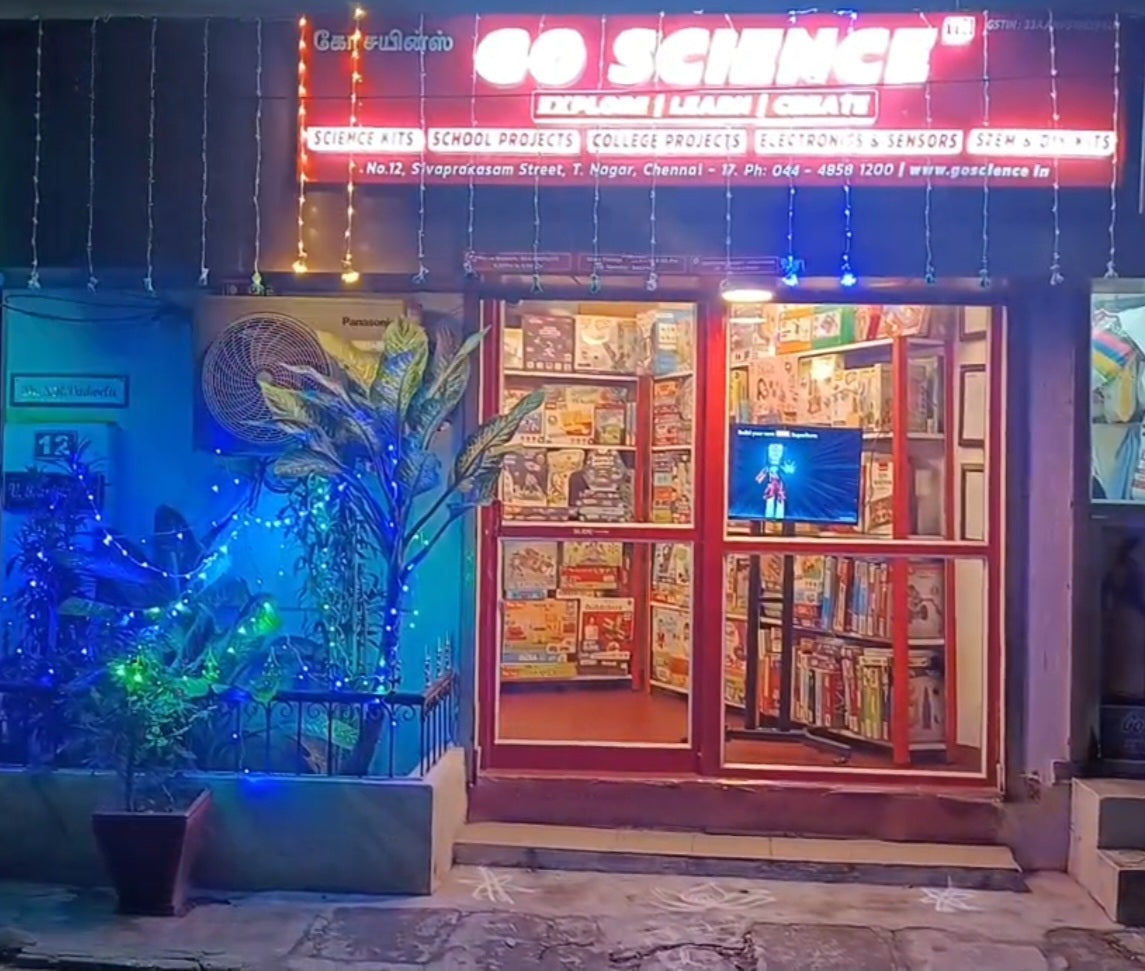
CHENNAI T.NAGAR STORE
No 12, Sivaprakasam Street,
T.Nagar, Chennai - 600017
Near Natesan Park & TTD Temple
Phone: 04448581200
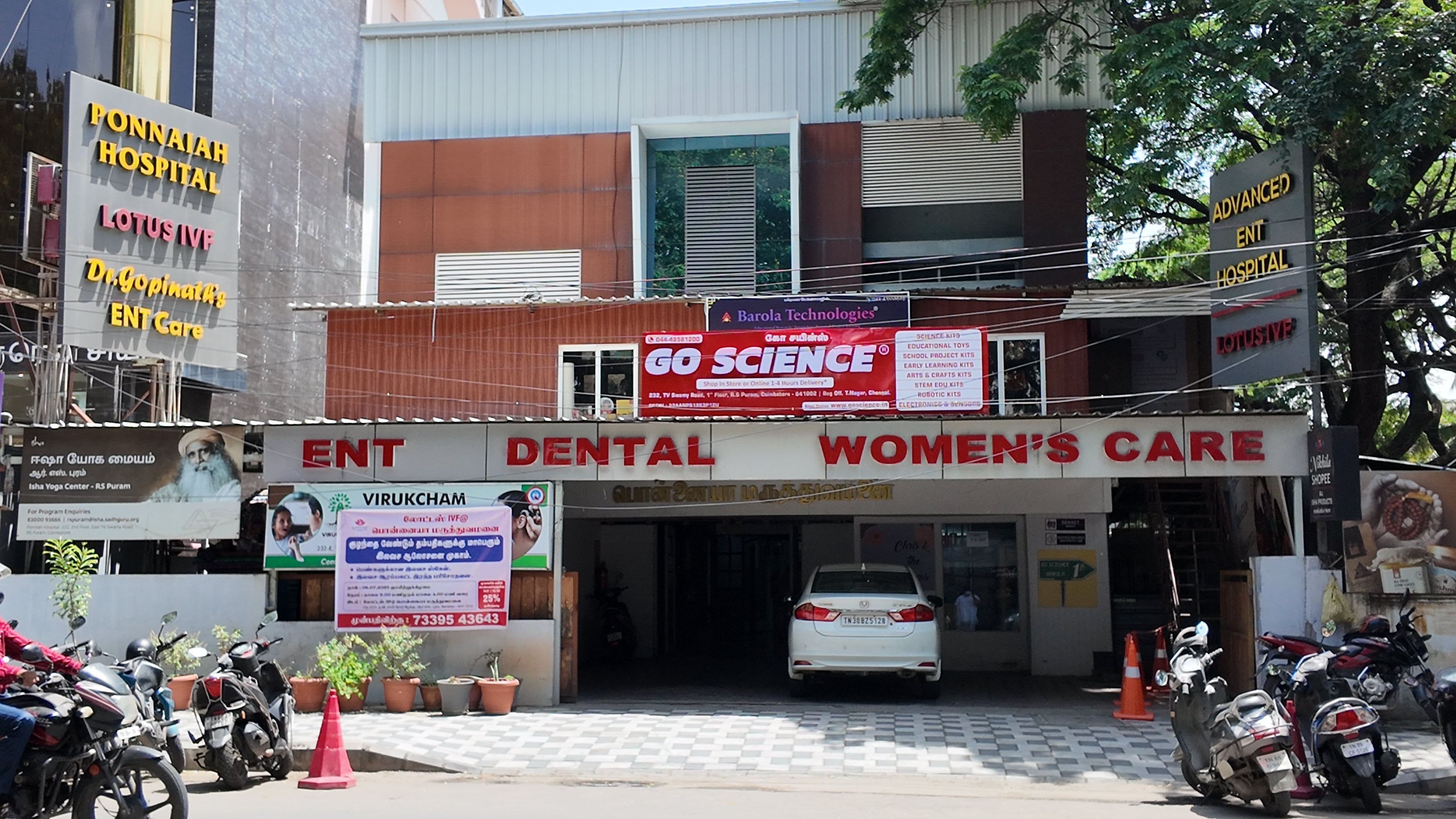
COIMBATORE RS PURAM STORE
232, T V Swamy Road,
1st Floor, R.S Puram, Coimbatore 641002
Phone: 04448581200

Bengaluru Store
No 154, Vinayaka Layout 1st Main,
Silver County Road, ,
Kudlu,
Bengaluru – 560102
(Opposite lane to DMart Haralur)
Phone: 04448581200